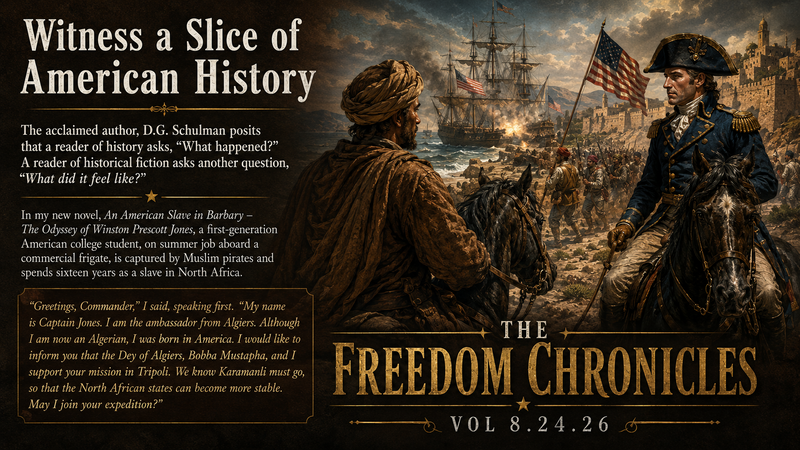
vol 8.24.26
The acclaimed author, D.G. Schulman posits that a reader of history asks, “What happened?” A reader of historical fiction asks another question, “What did it feel like?”
In my new novel, An American Slave in Barbary – The Odyssey of Winston Prescott Jones, a first-generation American college student, on summer job aboard a commercial frigate, is captured by Muslim pirates and spends sixteen years as a slave in North Africa.
The story spans the years of 1800 to 1817. As a writer of historical fiction, I created a fictitious narrator who meets actual historic figures and participates in real events. A great deal of history was made during these years of our nation’s infancy, the Napoleonic wars, the War of 1812 (called the Second War of Independence at the time), and the Barbary Wars fought by America versus the piratical states of North Africa, In so doing, I made sure the events and historic figures in my story were ly drawn and depicted with painstaking accuracy
I would add one descriptor to the genre. Historic fiction allows you to live in the past, or expressed another way, causing you to suspend disbelief. If done with accuracy and some knowledge of the human condition, it allows the reader to suspend disbelief, be transported to another time, and be a witness to a portion of history.
During his first four years as a slave in Algiers, my narrator, Winston, breaks under torture, becomes a Muslim, and rises to become an advisor to the Dey of Algiers. The Dey, Mustapha, receives word from his overlords in Constantinople that some American officers landed in Egypt and may be leading a mercenary army west to attack one or several of their client pirate states in North Africa.
Moustapha sends Winston west, to meet with the Bashaw of Tripoli to discover what he can about the American invasion. There in the desert on the eastern edge of Tripoli, Winston meets Willium Eaton.
Three and half years earlier, in May of ’01, the Bashaw of Tripoli, Karamanli, declared war on the US. Eaton was Consul to the neighboring state of Tunisia at the time of Karamanli’s declaration of war. He returned home with the plan to convince President Jefferson to finance his mission to raise an army in Egypt and march 800 miles to conquer Tripoli.
This is Winston’s first meeting with Eaton in the desert:
I never met with Karamanli but left Tripoli on good terms with his staff and rode East. One day past the city of Derna, the far east city of Tripoli, I encountered Eaton’s caravan. On a black stallion, he rode at the head of his soldiers, dressed in a blue formal uniform, with shoulder epaulets and a tri-pointed hat decorated with lace, buttons, and spurs of brass, all brightly polished despite his many days in the desert. Like Washington, he clearly understood the importance of maintaining the aspect of a commander. I halted on the road. As Eaton approached, he raised his right hand to signal his expedition to halt.
“Greetings, Commander,” I said, speaking first. “My name is Captain Jones. I am the ambassador from Algiers. Although I am now an Algerian, I was born in America. I would like to inform you that the Dey of Algiers, Bobba Mustapha, and I support your mission in Tripoli. We know Karamanli must go, so that the North African states can become more stable. May I join your expedition?”
“An American? And you wish to take up arms and fight with us?”
“I do.”
“I am not in a position to refuse a new armed soldier,” he said, with easy candor. “Will you fight under our banner without pay?”
“I wish to do precisely that, Commander. I have my own weapons and ammunition.”
“When we make camp tonight, please join me for dinner. I warrant your knowledge of Barbary will be most valuable.”
My plan, once I found Eaton, was to ask to join his regiment as a mercenary. If he would have me, I gambled that Mustapha would not know I had done so. And even if he did find out, I reasoned that I could always claim I had joined the Americans as a spy. My reason for attempting this ruse was that, if I were ever captured and forcibly repatriated, I would likely stand trial for treason. In this case, perhaps Eaton would testify in my defense.
When I joined them, Eaton’s men had been traveling twenty-five miles a day for more than four weeks. They were running out of food and water. His force was shrinking, as many of the Egyptians had deserted. But he seemed unfazed by his difficulties. His belief in himself was remarkable.
On the eve of the battle for Dern, I write:
On the night before our siege, I was invited to dine with Eaton and O’Bannon. Eaton asked, “So how does an American-born citizen become an Algerian ambassador?”
“I was on a merchant ship that was captured near the Strait of Gibraltar,” I replied.
“How did you arrive in Algiers?”
“I was sold at an auction in Morocco and delivered to the Dey of Algiers,” I said after swallowing a mouthful of salt pork.
“Why did the Dey of Algiers want you?”
“He was looking to acquire an American who could speak Arabic. I was that person. ”
Here is the battle:
On April 27, 1805, the former Bashaw of Tripoli, Hamet, William Eaton, Presley O’Bannon, ten American midshipmen, our Greek, Egyptian, Bedouin mercenaries, and I prepared to storm the City of Derna.
At noon, the bombardment began from three American ships anchored in the bay within range of the city. The American ships USS Nautilus, Hornet, and Argus began firing their cannons into the fortress city. The Hornet was positioned one hundred yards away from the fort and immediately began doing major damage to the city walls.
Next, Eaton ordered us to move down the hill, close to the enemy’s defenses, and wait for the bombing to halt. After the ships fell silent, Eaton gave the signal to run toward the fortress wall. I was among the men who made the charge. Despite the bombardment, Tripolitans armed with muskets still manned what remained of the walls. All of us attacked on foot, except Eaton, who led the charge on horseback. I was amidst O’Bannon’s Marines.
As I ran, a man on my right fell, terribly wounded in the shoulder. Another man on my left took a bullet to the chest and died instantly. During the charge, Eaton suffered a bullet wound to his wrist. With Eaton wounded, O’Bannon took command. Meanwhile, Hamet’s forces of about seven hundred men, positioned in the rear of the fortress, began to attack the city through a ravine that led to the north-facing walls.
When we reached the base of the severely damaged fort, the Tripolitans manning the walls abandoned their posts and fled into the city. This allowed us to climb our ladders and begin pouring into the town. Once there, we could see Hamet’s flag flying from the governor’s palace. The Tripolitan defenders on both sides of the fortress melted away into the city. The battle was won. Our contingent that mounted the frontal attack lost fourteen men. Hamet lost more than a hundred.
What connects both this story of an American enslaved in North Africa and my first book, Lessons from Fallen Civilizations, is that freedom is never free. Freedom is always under siege.
Join the Discussion
Create an account or sign in to leave a comment.