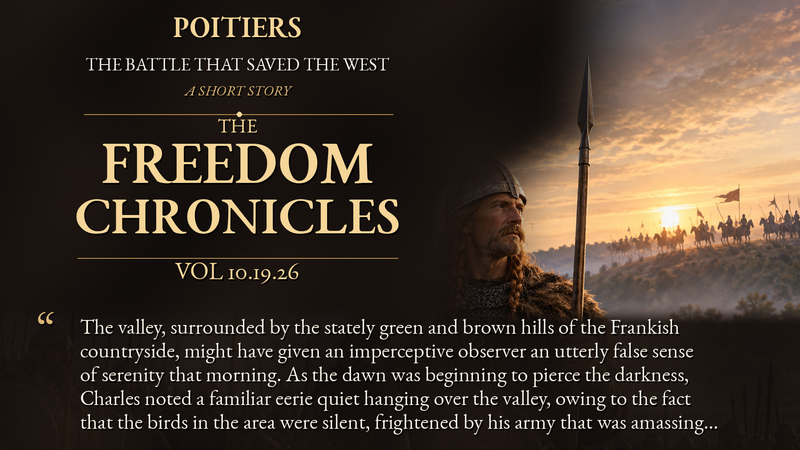
vol 10.19.26
Dear Readers,
What follows here is an excerpt from Lessons from Fallen Civilizations. In historic fiction, it depicts the Battle of Poitiers where Charles Martel saved Western Judeo Christendom. As Edward Gibbon put it, if Martel had not won at Poitiers, in his day, “… the boys of Eaton would be learning their lessons in Arabic.”
Poitiers – The Battle that Saved the West -
A Short Story
The valley, surrounded by the stately green and brown hills of the Frankish
countryside, might have given an imperceptive observer an utterly false sense
of serenity that morning. As the dawn was beginning to pierce the darkness,
Charles noted a familiar eerie quiet hanging over the valley, owing to the fact
that the birds in the area were silent, frightened by his army that was amassing
on the Roman road to Tours and by the Saracens who were preparing for battle
just over the horizon on the ridge above.
This must surely be the day that Rahman (Abd al Rahman al Ghafiqi, Emir
of Spain) will attack me, Charles thought. For six days, Charles sent his scouts
up to an adjacent bluff to watch Rahman’s men while the mounted Saracen
warriors had been watching his army from the edge of their camp. Unless a
large body of Arab reinforcements had come in under the cover of darkness
the night before, he judged the two armies to be roughly the same size, between
twenty- to thirty-thousand men each.
So that he personally would not be an easy target for the Saracen archers,
Charles dismounted and, in the still dim light, sent his horse off the battlefield
with his squire. He walked between two rows of men near the front of the
formation and took up his position inside the first phalanx positioned nearest
the enemy ridge.
His battle dress was very similar to the Greek hoplite soldiers who fought
at Marathon. His Germanic battle costume had changed little since the days
when they were the Rhineland tribes of Batavians, Chattans, Riparians, and
Alamans, peoples now fading into the shadowy past, that confederation of
tribes the Romans called the Franks. He was a proud Germanic warrior who
came from the eastern side of the Rhine, from a people never subjugated by the
Roman Empire. He led an army of heavy infantry of hardened Teutonic tribal
warriors.
Charles was clad in simple armor to be indistinguishable from the
rank and file of his army. He wore a conical helmet, out of which poured two
long braids of red-brown hair that reached nearly to his waist, and a coat of
mail that hung to his knees. A vest of animal skins covered his upper body. His
leather shoes were secured by long leather straps which crossed each other
around his shins and above his knees. In one hand he carried a round shield
with its boss drawn out to a point and in the other, he carried a fifteen-foot pike
with a sharp iron tip. On his belt, there was a Frankish battle ax, a dagger, and
a double-edged sword, all sheathed in leather.
His face had a reddish flush with piercing pale blue eyes and a mustache
that hung three inches below his cheek bones that contained some conspicuous
long grey members. His face was weathered but contained no battle scars.
Although his adult life had been one consumed by near constant war, Charles
had never been wounded and had never been in a losing battle. He was
powerfully built and, like most of his tribesmen assembling on the green
meadow, he stood over six-feet tall and would tower over the mostly five-foot
tall Bedouin scouts who were beginning to be arrayed on the overlooking bluffs,
mounted and ready for battle. Charles was thirty-two.
He was more troubled than he had ever been in the moments before a battle. As was
his habit, he prayed, or at least he tried. The relationship Charles had
with his God had been a practical one. Charles spoke a “barbarized” Germanic Latin. He
could neither read nor even write his name. His confessor and tutor, an Anglo Saxon
monk, Benedictus, taught him to say his prayers in the pure Latin of Virgil. On the evenings
of this campaign to the Aquitaine, he also read to Charles from the Roman historians,
Polibius, Livy, and Tacitus. Charles could not comprehend the omniscience of his God. He
believed that his prayers and those of his soldiers and subjects needed to be delivered in
the classic Latin Charles Martel of the Pope in Rome for the Lord to heed them. And for God
to hear his entreaties, Charles believed that his prayers needed to be spoken in the same
language that Virgil and the Pope in Rome spoke. Benedictus, who had been commissioned
by the Pope to convert the pagans of Gaul, had accompanied Charles on two previous
campaigns in central Francia, the new name being used for the region of independent
duchies and counties that made up the area north of the Alps and west of the Rhine.
Now, on the cusp of battle, Charles was too nervous to pray or even remember the prayers
that Benedictus had taught him. If there is only one true God, he thought, certainly He
favors the enemy. Why else had so many Christian lands, Syria, Palestine, Egypt, Spain,
and Septimania (the Pyrenees Kingdom) fallen to the sword of Islam?
If there is one true God, Charles thought, He must favor them. “How can I
possibly win today?” the great warrior asked himself. Then mused, “If He does
favor them, I will certainly die today.” At that thought, remorse began to weigh
upon his spirit. All his adult life, Charles had fought and killed men, pagans
and Christians alike, some of whom had even grown up in neighboring villages
of Austrasia, even men from his own clan. Was his quest to bring order and a
common rule to these lands of Francia worth their lives? He dreaded the answer.
When he awoke earlier that morning, Charles prayed that God would
forgive him and somehow give him a sign that He favored his cause, a sign that
He was a Christian God and not the Saracens’ God. “God, give me a sign that I am
worthy,” he tried to pray under his breath. As he did so, he noticed his mouth was
very dry, so much so that his tongue was swollen and he a felt an overwhelming
nausea that he hoped the warriors around him could not see.
On a road the Romans had built between Poitiers and Tours, Charles’
army was arrayed in five phalanxes, two on one side of the road and three on
the other. His army, like a single organism, sensed that this would be the day
the battle would start. Some of Charles’ newest soldiers were more eager than
their brothers-in-arms for the fighting to begin. These were the men of Poitiers
who had joined Charles’ army after their village fell to the Saracens two weeks
earlier, before the Austrasians arrived. These new soldiers were those who had
escaped the village. Many had lost loved ones and neighbors, either killed or
captured, at the hands of the Arab horsemen who had stormed the unfortified
village and looted the church and monastery.
The men of Poitiers stood and prayed as well; they prayed that
they would kill the captors and be reunited with a wife, son, or daughter, who
were held captive there behind the ridge in the Saracen camp. Nearly all the
208 The Fall of the Christian Middle East men of Poitiers begged Charles
to be placed on the front-line of the phalanx and be given their own iron-tipped
pikes so that they could be the first to face the Arab cavalry charges. In the
gathering light, Charles held back his tears as he thought of these men of
Poitiers who were so desperate in their grief, fearing that too many would not
survive the day to free their families.
Adb al Rahman, Emir of Andalusia (Islamic Spain) awoke around the same time Charles
found himself unable to pray. He stood for several minutes, contemplating
the dark sleeping form of his Jewish slave girl, Ximena. Outside he could hear
his army stirring, stoking their morning fires, and muttering about the battle to come.
He turned and walked outside his tent and brought back inside a burning
branch which gave off just enough light so that he could see Ximena’s face in the darkness.
Between blankets of luxuriant bear fur, she lay naked on a Persian rug.
She was restrained at her ankles and wrists by leather straps which led to stakes driven
into the earth off the edge of the rug.
She awakened when he entered the tent and shined the light in her eyes.
A year earlier, in an early morning raid, her father and two brothers were
captured and beheaded. She and her mother were taken as slaves and were
entrained to be sent across North Africa and back to Syria. Word reached
Rahman of the recently captured beautiful Jewess. Upon seeing her, he decided
to keep her as his concubine while he was in the north leading raids into Francia.
Ximena was seventeen.
She possessed eyes the likes of which he had never seen. Rahman had more
than a dozen concubines in his harem in Cordoba, the Islamic capital of Spain,
and had been offered and refused hundreds of other slave girls, products of
the Islamic conquests of northern Iberia, the Pyrenees, and the Mediterranean
Coast of Aquitaine. He had never beheld a woman whose eyes could hold him in
its grip. Each iris was a luminous emerald green with a band of darker green
around its outer rim. What held him transfixed was not simply their utter jewellike
beauty but the staggering emotion they conveyed: rage, hatred, and horror.
Her gaze penetrated his warrior soul and had the odd effect of enslaving him to
her. Knowing that the Prophet had captured a Jewish wife, Rihana, it was his
dream that she would become his willing princess and that he would take her to
Damascus to meet the Caliph. He dreamed that they would travel there by the
northern route across conquered Islamic Europe.
Charles’ Austrasian warriors were the Teutonic recipients of an ancient
oral tradition. For centuries they recounted, over their campfires, legends of
their ancestors who they believed were the descendants of Troy, descendants
from the men and women who found their way to Germania after the Greeks
had conquered the city. In the early morning before the battle, they must have
watched as the gathering light revealed more Bedouin horsemen forming up
in their ranks on the ridge.
Presently, they witnessed what no one born in Northern Gaul or Germania
had ever seen—a massive Saracen cavalry charge. Ten thousand horsemen
began galloping down from the ridge, shrieking at the top of their lungs, some
brandishing swords, others riding with bows. Charles had given the order to
stand firm and to remain in tight formation so that his soldiers’ shields would
touch one another and would provide a solid wall against the volleys of arrows.
The front row of men crouched behind their shields while the men in the inner
rows held their shields over their heads, creating a protective roof.
As Rahman’s arrows began to fly into Charles’ phalanx, most were deflected
by the bronze shields. Few men fell. As the Islamic riders reached to within fifty
paces, the men of his front rows hurled their pikes at the oncoming unarmored
horses, mortally wounding many and causing several hundred others
to stumble or fall. Horrific braying erupted. At the same time, hundreds of
Saracens were thrown forward, over the heads of their falling mounts onto the
ground, only to shriek loudly as they were trampled by the wave of riders
behind them.
Next, the Austrasians in the second and third rows of Charles’ phalanx
quickly moved up and replaced the front row and aimed their pikes outward
toward the onrushing horsemen. A wave of several hundred riders crashed into
Charles’ front line creating a near deafening explosion while horses and riders
were impaled. In this first charge, the Saracens failed to create an opening in his
phalanx where Charles stood commanding the battle.
In the space of a few moments, Charles was able to judge that his front
line had held firm with minimal losses inflicted by the enemy’s arrow men.
As he looked to his right, he could see the phalanx commanded by his cousin,
Dragobert, had also withstood the charge on it at its front flank, inflicting large
losses on the Saracen horses and riders, and he could see that they were moving
forward approaching the slope which led up to the Saracen encampment. He
could also see that they managed to stay in formation while passing over the
quivering mass of wounded men and thrashing horses which issued huge
braying noises.
As the day wore on, Charles’ five phalanxes sustained frontal and lateral
attacks by the mounted Saracens. Their charges were aimed at panicking the
Teutonic ranks, with the aim of causing their lines to break into disorganized
leaderless pockets, so that they could be struck down from sword blows and shot
in the back by arrow men. Charles’ phalanxes held and their formations were not
breaking down, so determined were the Franks to kill the Saracen invaders.
What Charles could not see was that the discipline among Rahman’s troops
was breaking down. This was the result of a panic that was infecting the Arabs
and North Africans as they began to see that it was possible they might lose
this battle. And in so doing, might also lose the vast stores of plunder and slaves
that they had amassed over the previous eighteen months of campaigning in
Southern France. The panic spreading among Rahman’s warriors stemmed
from the desire of each man to get back to camp, gather his plunder and head
back to the safety of the lands on the other side of the Pyrenees. Temporal greed
was overtaking their lust for infidel blood.
Rahman rode along the crest of the ridge at the head of about two-hundred
mounted elite riders who were his bodyguards. As he was about to issue the
command to charge, he glanced off to his right and could see hundreds of his
Saracen riders retreating back up the hill while one of Charles’ phalanxes was
pushing them slowly up the hill. With that he shouted to his men to charge that
forward column of Franks. Two hundred elite riders began to gallop down the ridge
toward Dragobert’s advancing soldiers. Leading the charge, Rahman had closed
to about fifty feet from the Franks when an airborne pike struck him just above
his groin on his right hip, penetrating through him, his saddle blankets, and into his horse.
This caused his horse to stop suddenly, throwing him to the ground. In the fall,
the pike tore itself out of his flesh, leaving a gaping hole in his right hip which
gushed blood. One of his bodyguards saw that he had been wounded and thrown,
rode up and hoisted him on his mount. Rahman knew that he was mortally wounded
and ordered his adjutant to take him to his tent. He had an overwhelming desire to be with
his personal belongings, including his beloved slave, Ximena, before he died.
As Rahman and his bodyguard mounted the ridge and approached his
tent, thousands of Saracens were swirling around them, screaming at one
another, while desperately trying to gather their belongings and captives, and
make their escape before the Franks could converge on the camp.
When Rahman entered his tent, he was unable to stand and ordered his
bodyguard to carry him to the rug next to where Ximena lay under her animal
skins. Knowing that the Arab commander was near death, the bodyguard quickly
left the tent without a salute or even a farewell. He had his belongings to collect.
Ximena had been a captive for nearly a year and was from a small coastal
village near the major port city of Narbonne, which had fallen several years
earlier. The Koran forbade the killing of the infidels if they surrendered to
the warriors of Allah. But the citizens of Narbonne had chosen to fight the
Arabs because word had reached them that other villages in the Pyrenees had
surrendered only to learn that they would have to sell their children into slavery
to pay the gizya, the Arabs’ tax levied on the infidels.
After its fall, all the surviving men of Narbonne were killed. All the women
and children were taken as slaves. The residents of Ximena’s village were
bypassed when Narbonne fell. But two years later, in a surprise raid, the luckless
souls of Ximena’s village were not given the option of surrender. Rahman needed
to provide his army with plunder and, especially, slaves as a means of payment
for their service. Slaves were more easily acquired than minted gold pieces.
With the gaping wound on his side bathing his lower body in blood, some of
which was already turning brown, Rahman rolled his head toward his beautiful
slave and looked at her with a longing, helpless gaze, a look which asked for
tenderness and forgiveness.
During the day, Ximena had been able to work herself free of the leather
straps that bound her. Free to move around his tent while he was away at the
battle, she found his dagger that she knew he kept in a satchel next to his bed. She
had now hidden it under her rug. If the Saracens had won the day and defeated
the Franks, her plan was to wait until Rahman returned to his tent. After he had
raped her and gone to bed, she would kill him with his own knife and make her
escape into the forest. Now, listening to the chaos going on outside the tent, she
knew that the Saracens had lost the day, that they were in full retreat, and that
Rahman was dying right before her eyes. With all the crescendo of confusion,
she concluded that, with the impending invasion of their camp, the Saracens
would overlook collecting the commander’s concubine.
Seeing his utter helplessness, she sat up, exposing her naked breasts, and,
brandishing Rahman’s own dagger, she spoke to him for the very first time in
perfect Arabic, “My father and brothers whom you killed await you! They are
the saints who will throw your filthy soul into hell!” With that, she slammed his
dagger into the center of his chest and his ghost made an audible sound as it left
his lifeless body.
Charles looked up to see one of his warriors, Theobald, whose father had
been a boyhood friend, approaching him though the shambles of the Saracen
camp. Theobald held a rope led to Ximena’s bound wrists. As he pulled her behind
his horse towards Charles, she struggled to straighten the Arab commander’s
tunic she had taken from Rahman’s tent. She had no sandals for her feet. She
had been rehearsing, for the entire year of her capture, the speech which she was
about to deliver. Charles spoke a Latinized Germanic tongue. Ximena had a great
gift for languages, a gift that her father recognized would have made her a much
better manager of his import business than even he. She had the ability to rapidly
master many of the tongues of the Mediterranean and commanded a powerful
aura with her speech, especially in the company of men.
Theobald called out to him. “Sire, the prisoner is a Jewish slave girl who
wishes to speak to thee.”
When she reached him, Ximena looked up at Charles and waited for both
horses to come to a complete stop. Peering deeply into Charles’ eyes, she said
slowly and loudly in Gallo Roman, “Sire, I have spent an eternity as Rahman’s
slave. I know the Saracens’ plans. I beseech you, keep me so that I can tell you
what they will do next. I know what the Arabs think. Please Sire, if you keep me
I will help thee to capture all these lands and make Francia yours alone. I will be
your concubine if that is what you wish. You need me.”
When she said, “You need me,” the sound of Ximena’s voice and gaze
produced an overpowering sensation that time was standing still. It also had the
effect of muting the sounds of his army’s mopping-up operations—the sounds of
summary executions necessitated by the fact that Charles forbade the taking of
slaves and by the fact that food provisions were extremely limited. Her presence
was for him a profound religious experience. He surmised that the Lord had
spoken to him through the vessel of this strange and beautiful slave woman.
While he looked into her eyes and into eternity, Theobald broke into his
reverie, “Sire, what shall I do with this prisoner?”
“Order a rider to take her to the abbey in Tours. Tell the Abbotess that I
asked that the slave girl be given residence there, and I will visit in a few days.”
“Yes, Sire.”
Before the soldier could lead her away, Ximena said, “Will I see you there, my
Lord?”
“Yes,” he said as he watched her being led away, escorted to where she could
be outfitted with a horse for the one-day ride to Tours.
Join the Discussion
Create an account or sign in to leave a comment.