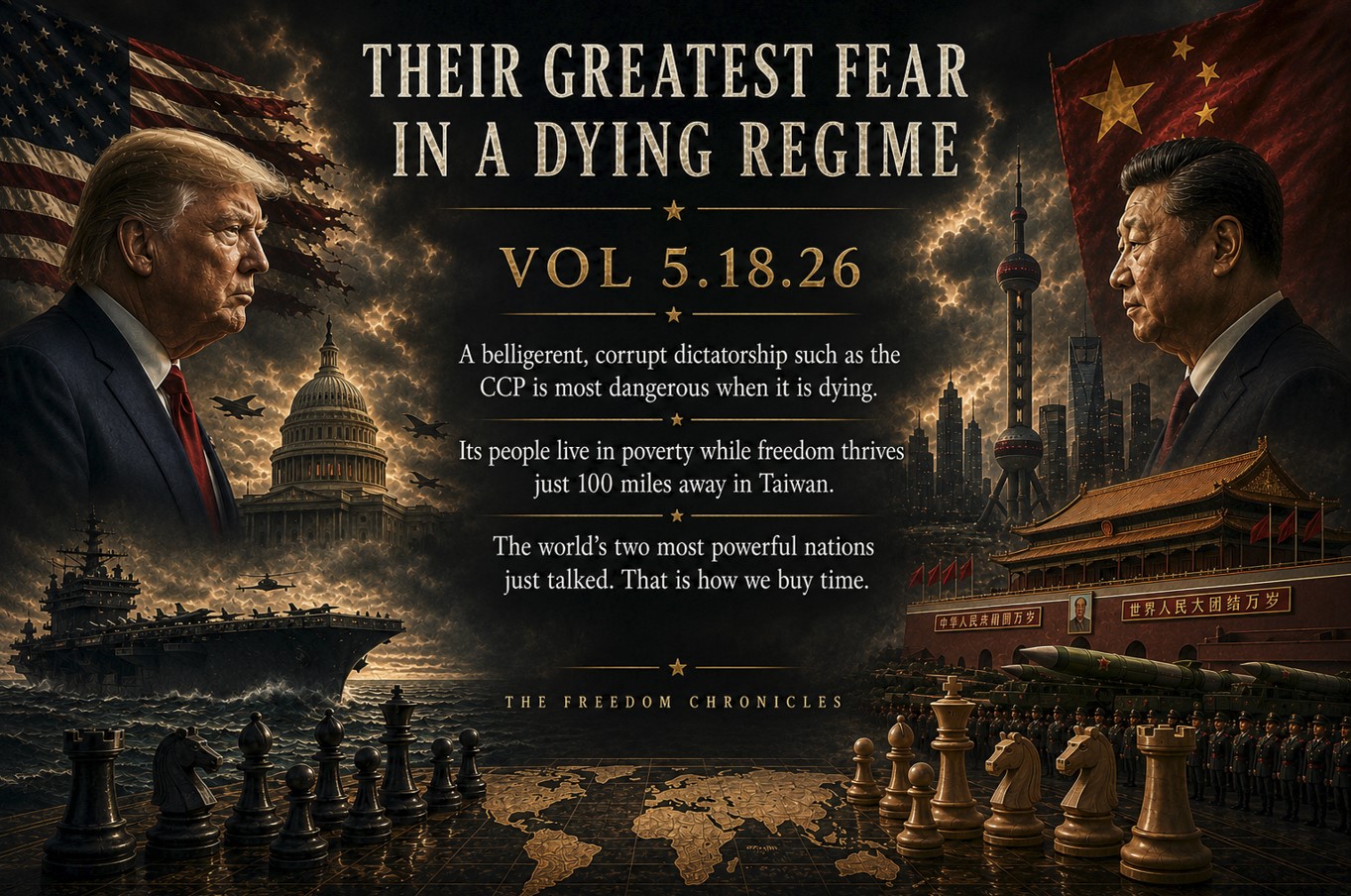
“A belligerent, corrupt dictatorship such as the CCP is most dangerous when it is dying,” Marc Thiessen observed in the aftermath of this mostly uneventful summit. China’s birthrate is far below replacement and is the lowest in the developed world. It will soon have too few workers to support its retired and elderly, he reports.
China’s annual per capita production of goods and services is only $14,000, whereas in the U.S., it is $95,000. Despite the alarmists in the media who try to portray China as our equal militarily, it is already a declining power, in crisis, whose population is mostly poor and becoming poorer. Yet, for the present, that makes the Communist regime more dangerous than ever.
Although our administration’s primary objective in this Summit was to obtain help in subduing Iran, Chairman Xi began the summit by invoking the classical world. As when the Greek city-states of Athens and Sparta went to war, he told our delegation, the United States should beware the “Thucydides Trap.”
In a thinly veiled threat, he ominously warned that Beijing and Washington could be entering an “extremely dangerous place” if the U.S. sought to impede China when it moved on Taiwan. The “Thucydides Trap” is named after the ancient Athenian general, whose account of the Second Peloponnesian War (431 B.C. to 404 B.C.) is considered the first recorded Western military history (and is described in my first book, Lessons from Fallen Civilizations)
Thucydides argued that the war between Athens and Sparta was driven by the threat posed by one rising power to an established power. The rise of Athens frightened Sparta and forced them into war, he wrote. When an established great power (the U.S.) meets a rising power (China), conflict between the two is likely, if not inevitable, Xi stated.
For the present, Xi’s analogy does not hold up. Our current administration is attempting to reduce the risk of warby various lesser non-kinetic means, such as restricting trade in advanced semiconductors and limiting China’s ability to keep up in the AI arms race. While the Chinese and American economies are increasingly in direct conflict, with China flooding the world with heavily subsidized, underpriced goods that damage, if not destroy, some Western manufacturers, the U.S. is responding by merely trying to rebuild its industrial base.
War with the West may be the Communists’ only salvation. The reason that Xi and the senior-most leaders inside China are obsessed with Taiwan is that they fear their own people. They fear that the freedom and prosperity their fellow countrymen enjoy in Taiwan, just 100 miles off their coast, could ignite a wildfire of revolution across mainland China. When the men ruling the world’s largest police state go to bed at night, this is their greatest fear. In a collapsing economy, war with the West might be the only means to unify the country under their authoritarian rule.
Despite this administration’s best efforts, an uneventful summit is probably a good outcome. The U.S. needs time to break China’s critical mineral monopoly and move its vulnerable supply chains out of China. And with global trade already constrained by the blockades of the Strait of Hormuz, the Administration is attempting to avoid further trade disruption while it strangles the Iranian theocracy and waits for regime change.
The biggest takeaway from this summit is that the leaders from the world’s two most powerful countries sat across from each other and talked. Trump stated that Xi would come to America in September for another summit. While we did not forge a new treaty with the CCP, and while the administration was not able to improve human rights inside China, and while it did not secure the freedom of China’s most prominent political prisoner, Jimmy Lai, we bought time while we continue to bolster our alliances in the Eastern Pacific, with South Korea, Japan, Viet Nam, Australia, and, yes, Taiwan.