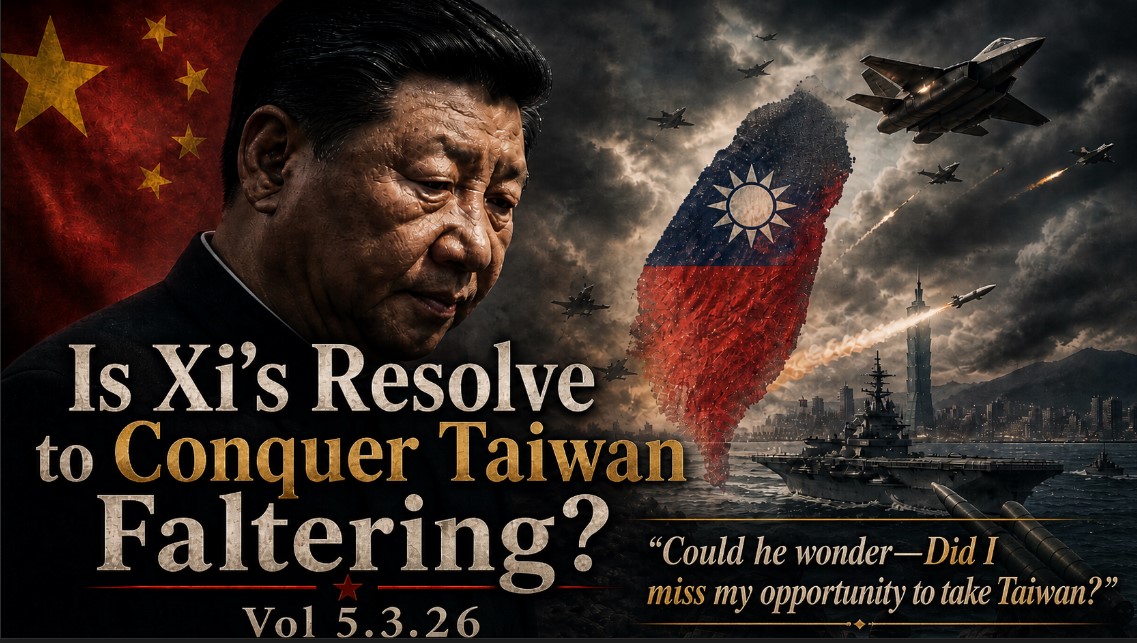
Vol 5.3.26
As the summit in Beijing approaches, it is important to note that the prosecution of the war in #Iran by America and #Israel has exposed a vulnerability in the Chinese military. The inferiority of the Chinese anti-aircraft systems employed by Iran was on full display as they were immediately destroyed last August by the Israeli and American air forces without the loss of a single plane.
Most of us who follow national security dread the prospect of #China invading Taiwan. Yet few in the mainstream media seemed to notice that the threat from the Chinese military is weakening. Why is that? In China, the head of the military is the Vice Chairman of the Central Military Command and is the equivalent of our Chairman of Joint Chiefs of Staff. Chairman Xi has removed eight of his military chiefs. This, in turn, has sent shock waves through the hierarchy of the Chinese Communist Party (CCP).
The most recent removal of a CCP Military Chief, Zhang Youxia, occurred in January of this year. While some removals have been carried out quietly, others have been carried out amid accusations of corruption. In Communist China, an accusation is tantamount to a conviction. According to the recent CSIS reports, only one of the original six generals on the Central Military Commission (Zhang Shengmin) is left.
The Vice Chairmen sit atop an enormous military pyramid of corruption, convulsing the entire regime. As I wrote in last week’s Freedom Chronicles, “the theft (inside the military) is so widespread it is “systemic, a form of spoils-sharing, the norm of monetizing power.”
There is something else driving the collapse of senior command in China’s military. It stems from the slogan first coined by Chairman Mao, “Political power comes from the barrel of a gun.” This meant that true power was believed to reside with whoever commanded the military.
Traditionally, the Vice Chairman has been the man closest to the chairman and commensurately, the man most capable of disposing him, the greatest threat to mount a political coup against him. In a corrupt dictatorship such as the CCP, it is safer for the Chairman to act preemptively rather than to wait to be undermined, helping to explain why so many of China’s most senior military chiefs have disappeared.
This does not change the fact that China maintains the second-most-capable military on the planet, with 1.6 million men under arms. During his 2025 Senate confirmation hearings, Secretary of State Marco Rubio stated that the Communist regime in China was “the most potent and dangerous adversary the United States has ever faced,” and added,” They possess elements the Soviet Union never had.”
Rubio went on to issue a stark warning. “If we stay on the road we are on, in less than ten years, virtually everything that matters to us in life will depend on whether China will allow us to have or not.”
Much has changed in the fifteen months since Rubio was confirmed. With the help of our ally, Israel, in a few weeks, the United States destroyed the Iranian air force and navy and reduced Iran’s military, formerly ranked the eleventh most capable in the world, to one incapable of projecting power outside its borders.
The ramifications of the war to rid the world of the Iranian nuclear threat are still playing out on the geopolitical three-dimensional chessboard. But it must be evident even to Chairman Xi that the American slide toward subservience to China has been reversed. Could he wonder—Did I miss my opportunity to take Taiwan?
The country’s greatest military historian, Victor Davis Hanson, writes, “The display of American air power and the evolving nature of 21st century tactics and munitions will likely also give China pause regarding Taiwan.” He goes on to describe the specter of a sea of smart mines, surface and air submarine drones, Taiwanese missiles, an allied fleet similarly equipped, and a Chinese bloodbath as the regime attempts to transport hundreds of thousands of soldiers across the 110 miles of open ocean.
At the peak of Napoleon’s power in 1804, he did not risk his army crossing the much narrower 26-mile English Channel to conquer Britain. Similarly, in 1940, when Hitler had conquered most of Western Europe, he also declined to contest the British navy by sending his army across the strait.
Mao, the father of Chinese Communism, in his programs to industrialize and collectivize a backward country, caused the starvation and death of between 15 and 40 million of his own countrymen. Hi successor, Chairman Xi, has inherited a regime without compassion for its own citizenry or the loss of civilian life. But he knows that the loss of tens of thousands of his military in an unsuccessful attempt to quickly conquer the Taiwanese island would bring him down and very likely cause the loss of his own life.
Join the Discussion
Create an account or sign in to leave a comment.