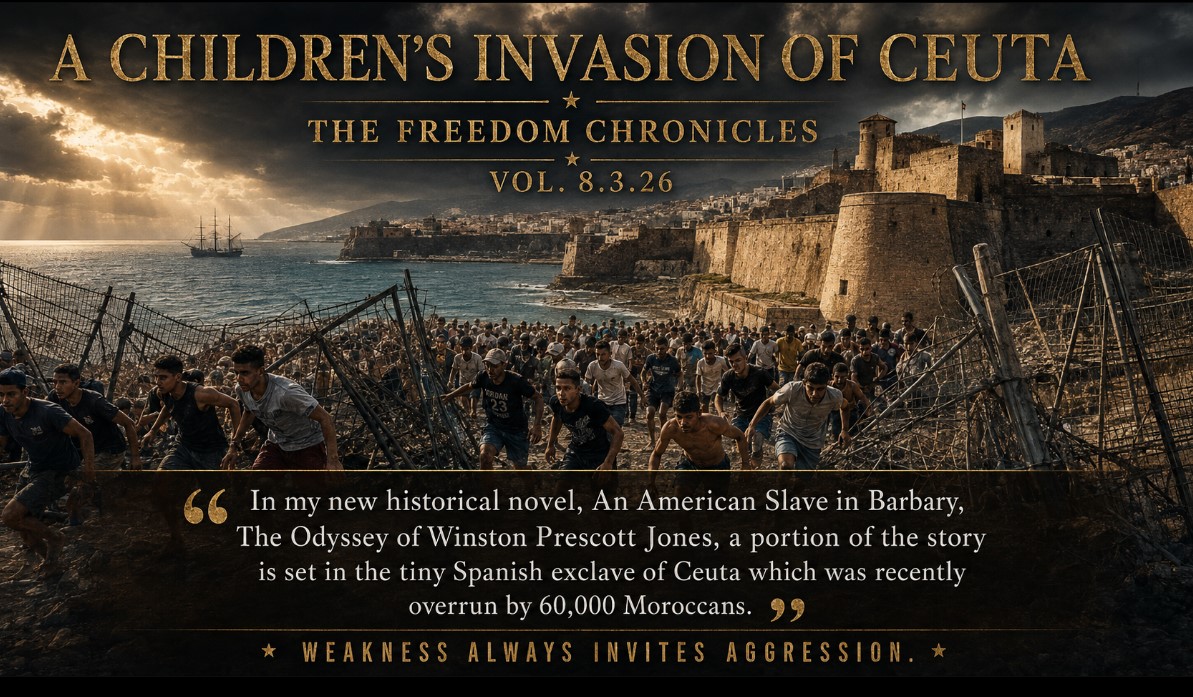
Vol 8.3.26
In my new historical novel, An American Slave in Barbary, The Odyssey of Winston Prescott Jones, a portion of the story is set in the tiny Spanish exclave of Ceuta which was recently overrun by 60,000 Moroccans.
In a news conference last Friday morning, Spanish Prime Minister Pedro Sánchez, ironically proclaimed, “The Government of Spain stands with the city of Ceuta. What happened was an attack, a violation of Spain’s territorial integrity. Ceuta is a Spanish city, and what happened deserves our full reproach, at the strongest possible level.”
The profound irony comes from the fact, that Spain, like most of Western Europe, has fecklessly encouraged a mass migration and colonization by Muslem people from North Africa and the Middle East.
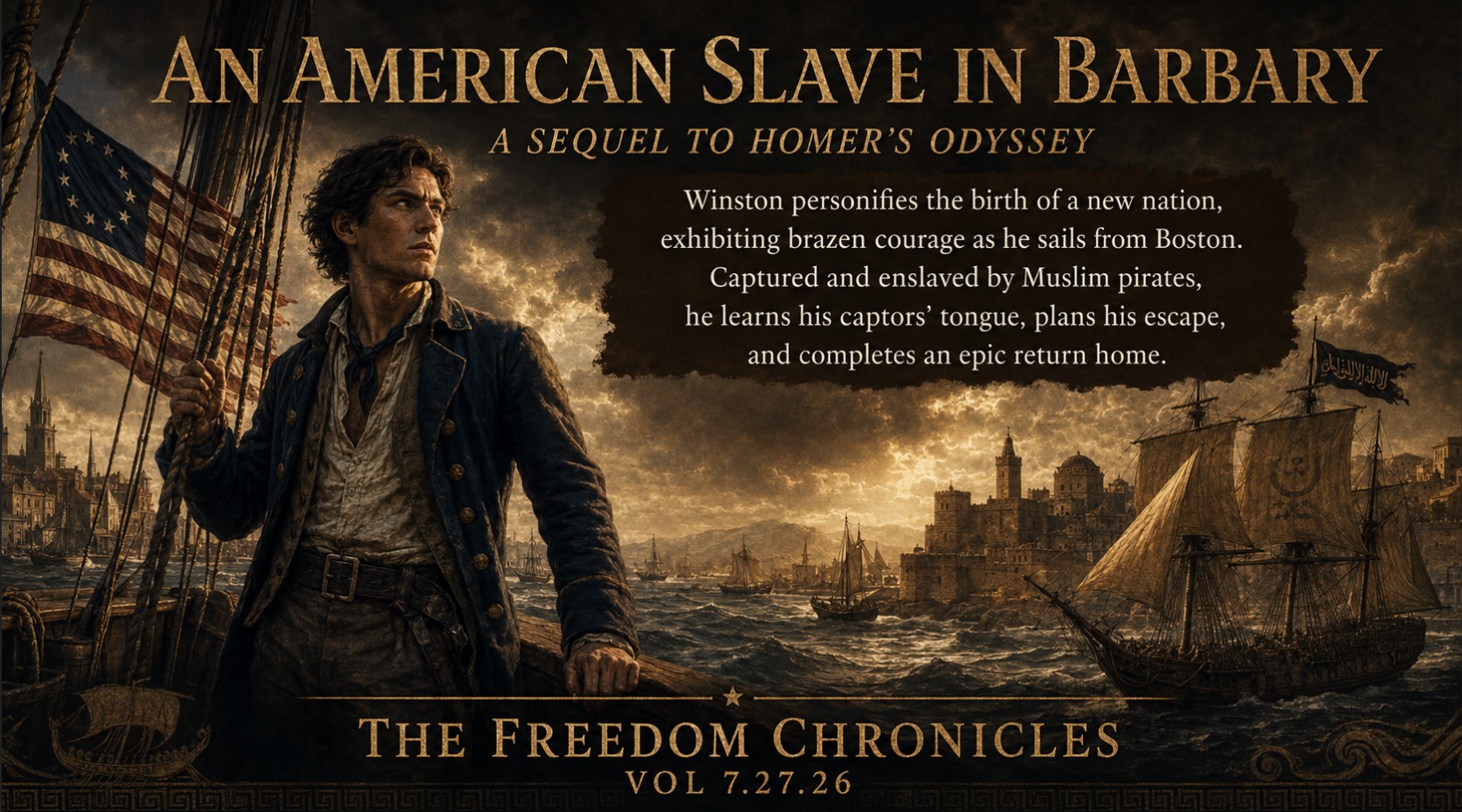
My novel takes place between 1801 and 1817. It is the story of an American student who, on a summer job aboard a merchant ship, is captured by Muslim pirates, and spends 16 years as a slave in North Africa where he rises to become an advisor to the Dey of Algeria.
In August of 1816, while Winston and his fellow captives man the citadel walls, a superior fleet of British warships, commanded by Sir Edward Pellow sails into the Bay of Algiers and in a two-day battle, destroys the city, its port, and most of the Algerian navy (similar to what the American and Israeli air power did to Iran). Surviving the battle and during the chaos, Winston makes his escape, and travels through the bandit-infested Saharan badlands, ending his journey at the walled city of Ceuta.
Once Winston crosses the drawbridge and steps inside the ancient city, he knows that his sixteen years as a captive of Muslim world had ended. He has returned to the West. In the book, I provide a brief history of how this tiny port city on the African side of the Strait of Gibraltar became part of Spain.
The peninsula had been inhabited for three millennia. Around
1,000 B.C., the city was home to history’s most intrepid seafarers
and the inventors of our alphabet, the Phoenicians. It later became
part of the Carthaginian Empire and served as a trading
center until Rome destroyed Carthage in 146 B.C. Septem, as it
was called, became the capital of the Roman client state, Numidia.
By the reign of Augustus and at the birth of Christ, the city had
been fully Romanized.
By the late fourth century, Septem was a port city of about
10,000 Roman Christian citizens. In the following century, while
the Roman Empire of the West was being dismembered by invading
Gothic barbarians, it was a major commercial center in what
was then the Roman Diocese of Africa. Its governor was a Roman
general, Bonifatius, who was himself of German ancestry, a Goth,
and was a Christian philosopher and a friend of Saint Augustine.
The city remained the captive of and subject to successive warring
Muslim empires, large and small, including the Almoravid
Dynasty, ruled by Berber kings based in Morocco.
The city’s liberation did not come until the morning of August 21, 1415, when
a Portuguese armada of two hundred ships carrying 45,000 men
surprised the unprepared defenders of Ceuta and took the city in
a single day. The following morning, the flag of Lisbon was raised
over the fortress city. Over the next fifty years, the Portuguese constructed
massive walls and created a formidable moat around the
city, rendering it nearly impregnable.
In 1669, due to a succession crisis in Portugal, the city became
part of Spain in a treaty called the Iberian Union. Then, in 1694,
the armies and navies of the Moroccan sultan, Ismail bin Sharif,
attempted to retake Ceuta, marking the most prolonged siege in
human history. The siege mounted against the Spanish forces defending
the citadel began in 1694 and ended in 1720. It resumed
in 1721 and finally ended in 1734, with the Moroccans repelled
and the Spanish still in control. The Moroccans made another attempt
to bring the city back under Islamic rule in 1790, but failed again.
The symbolism and extreme irony captured by the film footage of thousands of Muslims easily storming past the Ceutan barricades was stunning. When you consider the unsuccessful thirty-year siege of Ceuta by the Moroccan sultanate.
They young Muslims, mostly men and a few women, came flooding across the barricades, many in their bathing suits and no shoes, none carrying a backpack or even a bottle of water. Apparently, a social media meme, spreading like wildfire, told them that Ceuta would be the open door to European largess.
In my first book, Lessons from Fallen Civilizations, I remind the West that in the 100 years after Mohammad’s death in 632, Muslim armies brutally conquered the Chrisian realms of the Middle East, North Africa and all the Iberian Peninsula. It was only after the victorious Muslim armes crossed the Pyrenes and were swarming into Gaul, were they stopped by the Gothic Warlord, Charles Martel, Charlemagne’s grandfather.
Nevertheless, even after the invaders were pushed back across the Pyrenes, Spaniards seem to have forgotten Muslim’s ruled all or part of their homeland for the next 700 years.
This time most of the Muslims who shoved their way into Spanish territory received no largess, were not even given water, were rounded up, and sent home. But the children’s invasion provided a stark reminder—Weakness Always Invites Aggression.






Leave A Comment