Vol 7.20.26
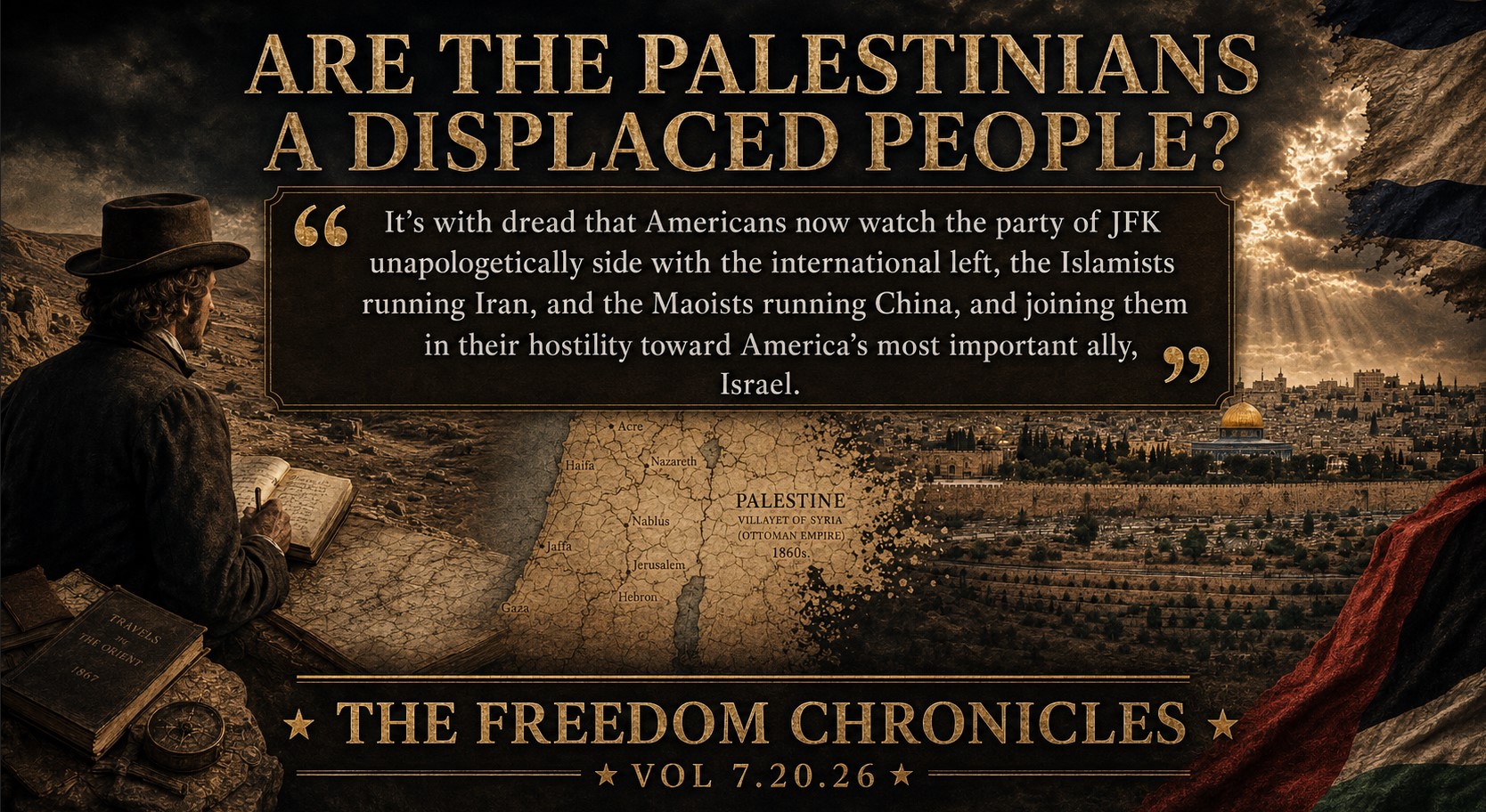
It’s with dread that Americans now watch the party of JFK unapologetically side with the international left, the Islamists running Iran, and the Maoists running China, and joining them in their hostility toward America’s most important ally, Israel.
While much of the Middle East has been at war with State of Israel since its creation in May of 1948, we have been told that that those making war on Israel were justified given the Zionist Jews confiscated the land from the Palestinians. But is that true?
Mark Twain traveled to the Holy Land in 1867 aboard the steamship Quaker City. It was one of the first organized pleasure cruises from America to Europe and the Holy Land. Twain visited Jerusalem, Nazareth, the Sea of Galilee, and other biblical sites and reported disparagingly of what he saw. The land had fallen so far into disuse, that most of what had been the Holy Land, he wrote, had become dusty and barren with very few permanent residents only primitive, nomadic people, passing through.
I wanted to find out where the Palestinian people came from. Had they deep roots in the Holy land, like the Israelites, dating back as far as 1,000 B.C.?
I decided to consult Claude, the AI search engine made by Anthropic of San Francisco, my hometown, to find out what the conventional wisdom says. I first asked, “Where did the Palestinian people come from?” It responded with:
The term “Palestinian” refers to the Arabic-speaking population native to the region historically known as Palestine (roughly corresponding to present-day Israel, the West Bank, and Gaza). Their origins are layered, and historians generally point to several overlapping strands:
The phrases “origins are layered” and “overlapping strands” are ways of saying nothing. Claude went on:
Ancient roots
The land has been continuously inhabited for thousands of years by a succession of peoples — Canaanites, Philistines, Israelites, and later populations under Assyrian, Babylonian, Persian, Greek, and Roman rule. Modern Palestinians are, in large part, descendants of these long-settled populations who remained in the region through all these changes of rule, gradually adopting whatever language and religion predominated at the time.
In summary here, the area has been colonized for a few thousand years by various tribes and sects who came and went and who adopted whatever language predominated at the time. In short, it was a region of transient populations who were, to use Twain’s term, “nomadic.”
So, if the area was colonized by polyglot of peoples over the past couple of millennia, from Canaanites to Babylonians, where did the name “Palestinian “come from? I asked Claude. It responded:
“Palestine” is old — the Romans named the province Syria Palaestina in the 2nd century CE, and the name persisted through Byzantine, Islamic, and Ottoman rule, and then as the British Mandate of Palestine (1920–1948). But that’s a placename, not necessarily a sovereign state.
Here the politically correctness of the search engine falls away. Palestine was the name for the area, a Roman province of Syria, a Roman bastardization of the name for Phoenicians who, we remember, invented our alphabet. It is a “placename” not a people. The question then one asks, “How can a place name be an aggrieved people?
Claude went on:
Arabization and Islamization
The most significant shift came after the Arab-Islamic conquests of the 7th century CE, when the region came under Muslim rule. Over subsequent centuries, the local population increasingly adopted Arabic as their language and Islam as their religion. This is when the population became “Arab” in language and culture.
So, by conquest in the 7th century, the population of Palaestina became Arabs or Arabic-speaking. That is, almost all the people became Arabs except the Jews, some of whom, remained in the area. The region was rules by numerous Muslim dynasties and caliphates until the fall of Ottoman Empire in 1917.
Claude had this to say about that period of Palestine history:
Ottoman era to present
Under Ottoman rule (1516–1917), the population continued to develop a distinct local identity, still primarily under the broader umbrella of “Arab” and “Ottoman” identity. A specifically Palestinian national identity — the sense of being a “Palestinian people” — crystallized more recently, mainly in the late 19th and 20th centuries, in response to Zionist immigration, British colonial rule, and the events of 1948 (the war surrounding Israel’s founding, known to Palestinians as the Nakba, or “catastrophe”), which led to the displacement of a large portion of the Arab population of Mandatory Palestine.
Here again, Claude lets its politically correct guard down. It tells us that not until the late 19th and 20th centuries did the “sense of being a Palestinian people” become “crystallized.” And why was it crystallized? They became a people in search of a state only due to the creation of the state of Israel, their “nakba” (catastrophe).
But certainly, I thought, the Palestinians can point to great leaders of their past who can give them a sense of identity, whose deeds and actions can speak to the existence of a long-suffering people and can give them pride in their heritage.
I asked Claude to provide me with a list of notable Palestinian leaders from the past. The first name it gave me was Amin al-Husseini, the Grand Mufti of Jerusalem.
Claude tells us he was “a dominant Palestinian Arab political and religious leader during the British Mandate era (1920s–40s); a highly controversial figure, including for his WWII-era collaboration with Nazi Germany. “
The next leader Claude sites is Ahmad Shukeiri, first chairman of the PLO when it was founded in 1964. The next is Yasser Arafat, the most internationally recognized Palestinian leader who led the PLO from 1969
In short, there were no leaders of the Palestinian people before 1964 when the Grand Mufti, al-Husseini collaborated with the Nazis because there was no such thing as a Palestinian people. It is a fabricated people with no claim to any land. Moreover, the average Arab living inside Israel can vote, even run for political office and has more rights than any of his Arab brethren living in any other Muslim country.





Leave A Comment