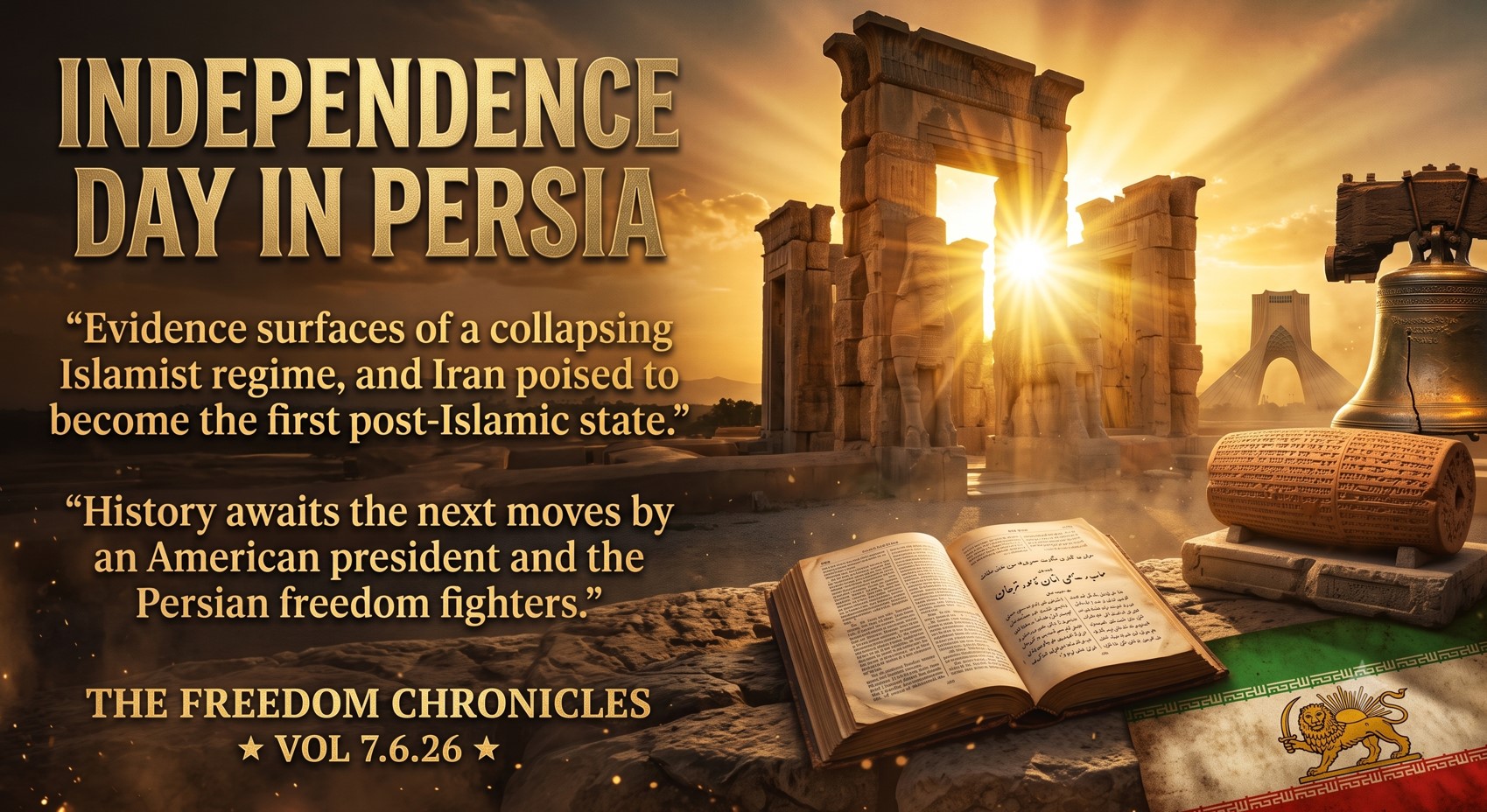
Vol 7.6.26
More evidence is surfacing to alert the #Iran watchers in the West that the Islamist regime is collapsing. Moreover, when it falls, Iran will become the first a post Islamic state. The significance of this event for the global economy and world order cannot be overstated. It will be a historic event, unseen since the seventh century when the conquest of #Persia by the murderous followers of their newly deceased prophet took place. History awaits the next moves by an American president and the Persian freedom fighters.
In a testament to the murderousness of the Islamists running the regime are, the Iran-Iraq War lasted eight years, from 1980 to 1988, killed between one to two million souls, while both sides were the followers of the Prophet. During that war, Revolutionary Guard Corps (IRGC) thugs set up checkpoints to entrap the population, raided homes, imprisoned and executed thousands on fake charges ranging from espionage to ideological deviation.
Last June, the IRGC arrested some 21,000 people across Iran during and following the war with #Israel and the U.S. last June. The murders were carried out under a near-total internet blackout that cut off communication nationwide. In the weeks that followed, the Iranian judiciary expedited the handling of all security cases tied to charges like moharebeh (“waging war against God”), a crime punishable by death.
But inside Iran, something mystical, some might say biblical is happening. Since Washington and Tehran signed a memorandum of understanding, the shelling of ships in the Gulf has greatly declined but has produced a renewed, more aggressive repression campaign inside Iran.
This crackdown can be seen as the regime’s response to the vast majority of Iranians who want to see it gone.
Since its founding in 1979, the Islamic Republic’s legitimacy has rested on its claim that it governs in the name of #Islam. “In Islam, the legislative power and competence to establish laws belong exclusively to God Almighty,” Khameini proclaimed once the revolution was complete.
Yet a 2025 study found that more than 70% of Iranians oppose the regime which melds Islam with the state.
Waves of protest continue in large and small cities across the country. Many of the protests feature calls for nationalism and secularism. But other gatherings are held in secret by Christianity converts..
Human-rights organizations are now reporting that Iran has one of the fastest-growing Christian populations in the world. In 2013, the Christian population was estimated to be less than half a percent, comprised mostly by ancient Armenian and Assyrian communities that predate Islam’s conquest of Iran.
In a secret location, 246 Iranians were baptized in a single day. It was the largest recorded baptism services in the country since the 4th century. By 2020, estimates are that the Iranian Christian population is the fastest.
In 2013, the Christian population was estimated to be less than half a percent, largely limited to ancient Armenian and Assyrian communities that predate Islam’s arrival in Iran. But in that year, 246 Iranians were reportedly baptized in a single day, the largest recorded baptism services in the country since the 4th century. By 2020, estimates suggested the Christian population had increased by more than 200%, with more than one million Iranians identifying as Christian.
Conversions take place quietly and out of public view. Underground churches have proliferated despite the risk of arrest and imprisonment. Bibles, which are considered contraband by the Islamic Republic, are smuggled into the country on compact memory cards. Iran Alive, an Evangelical organization based in Texas, claims to have distributed more than 100,000 Bibles in Iran since 2001, and now reaches an average of 6 million Persian-speaking Iranians daily via satellite broadcasts.
This growth has occurred even as the regime has continued to capture and execute its own people. The regime treats apostasy not as a matter of conscience but as a threat to the Islamist state itself.
The country’s protest movements do not call for Islamic reform. They demand freedom of speech and freedom from clerical rule. Some protest feature Iranian women publicly burn their hijabs. Young Iranians chant freedom. Their language and symbolism of dissent are unmistakably looking toward Judeo-Christian values.
None of these developments guarantee that Iran will emerge as a Christian society after the regime falls. But they do suggest that Iran may be, if it is not already, a post-Islamic society.
In 2023, a senior Iranian cleric acknowledged that of Iran’s 75,000 mosques, about 50,000 had closed. It was a “worrying admission” for a state built on the principles of Islam. He was forced to admit the regime’s attempt to fuse political authority with religious legitimacy over the past five decades had not produced a devout Islamic society. Rather it was a country where 80% of the people were actively looking for a better, freer society.
iran
Join the Discussion
Create an account or sign in to leave a comment.