VOL 7.27.26
Over the previous week, Christopher Nolan’s new film, the Odyssey, filled theaters and netted $80 million box office receipts despite mixed reviews and some controversy given that Nyong’o, a Black woman, was cast as Helen. The critic, Roger Ebert, gave it four stars. But most people who saw the film loved it.
Ebert points out, “Gods and humans from elsewhere in Greek mythology make appearances in the film. Nolan’s script mixes in bits of The Iliad, (Homer’s prequel), and The Aeneid, (by Virgil) making the film something like a 20th– and 21st-century translation of the Odyssey, with its own embellishments.”
The epic poems, the Iliad and the Odyssey are not only considered foundational to the formation of Western Civilization but written sometime in the 7th or 8th century BCE, they are believed to be the first major works written by a Western writer.
We know they are the first to be written down because it was precisely at this time that the Greeks were learning language writing skills invented by the Phoenicians. These ancient seafarers and traders had developed an alphabet which represented sounds rather than employing tedious pictograms. It is from them that we tellingly inherit the word, phonetics.
Homer’s stories were part of an oral tradition and were likely centuries old, composed and performed orally, sung or chanted by bards to musical accompaniment, retold across generations.
Their language was formulaic, composed of stock phrases that fit a meter, dactylic hexameter, a rhythmic pattern that made them easier to remember in performance.
The Iliad and Odyssey probably weren’t “written” by a single author sitting down with a pen. They were the product of a long oral tradition, with “Homer” serving as the name we’ve attached to that process. Whether one person did this final “writing,” or whether it was a committee effort, or whether it happened later under Athenian patronage is still being debated.
But one thing is certain—the impact that Homer had on the heroic Greeks who came after him, the Greeks who fought and defeated the Persian empire, who invented timeless architecture, constructed vast building projects , created stunning anatomically correct statuary, invented the scientific method, and who conceived of democracy, was profound.
As the scholar, Scott Masson writes, “What if Homer never intended to tell the ultimate adventure story?” He explains, approximately two centuries later, Plato in the fifth century, records that his teacher. Socrates taught that Homer was “the educator of Hellas.” (Greece)
For us, stories are entertainment. For the ancient Greeks, in the fifth and fourth centuries BCE, during their age of brilliance, they saw good stories as the builders of character, treatises that model wisdom and virtue.
Greek children learned of courage by observing Achilles, wisdom from Mentor, prudence from Odysseus, fidelity through Penelope. Long before Western philosophy analyzed virtue, Homer gave us its personifications. His story formed the bedrock form which Greek and Western culture were built.
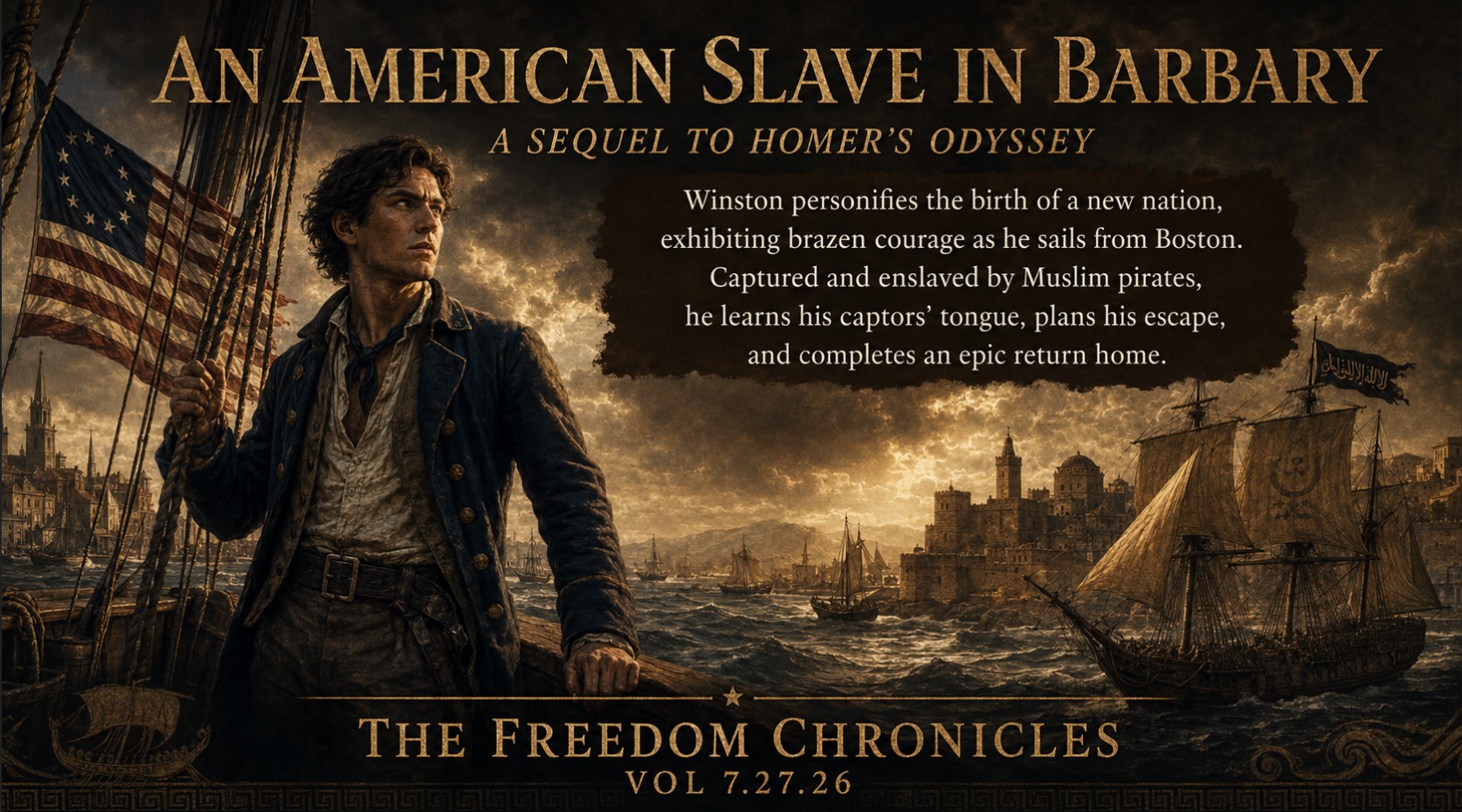
Enter my story, An American Slave in Barbary – The Odyssey of Winston Prescott Jones. It is the story of a young man who is the personification of our new American nation, the son of a man who was born a British citizen, who fought in the revolution, defeated the British, and was a founder the new nation.
Winston also personifies the birth of a new nation and who exhibits brazen courage by electing to work aboard a commercial vessel, leaving the safety of his home in Boston, to sail across the Atlantic as a summer job. During that crossing, he is captured by Muslim pirates.
After his capture and enslavement by Muslims, Winston personifies wisdom. He learns to speak his captors’ tongue and rises to become a confidant to the Dey of Algiers. While captured, and under torture, Winston renounces his religion and his American citizenship. But he never truly embraces Islam or pledges fealty to his captors’ lands in Algeria.
As the story unfolds, like Odysseus who yearns to return to Ithica, Winston plans his escape and completes an epic return home. My book pays homage to and is an American sequel to the Oddyssey.






Leave A Comment