My cousin, Robert Keeler, the celebrated military historian, in his piece "From the Halls of Montezuma," chronicles the events of our first foreign war, exposing truths about #Islam, relevant to the perils we face today. He writes,
In 1786, Jefferson traveled to London to meet with his good friend John Adams. Adams was the United States’ first ambassador to Great Britain and had invited Jefferson from Paris to discuss the danger posed by the pirates of the Barbary Coast. Without a navy, America had no way to protect its interests, but America’s economy could not afford to end trade on the high seas.
One key piece of America’s economic health was trade with southern Europe, accessible only by sailing into the Mediterranean, within range of the Barbary pirates. Roughly a quarter of New England’s most important export, dried salt cod, went to markets there, as did one-sixth of the country’s grain exports. The merchant ships provided employment for more than a thousand American seamen. The trade and employment were essential to the growing American economy.
The American government had approved payment of $80,000 to the North African nations, but the bribes they demanded were many times that amount and escalating rapidly. Unable to pay enough to buy the goodwill of the Barbary countries, America was forced to let its ships sail at their own risk.
A few weeks earlier, Adams had made a visit to the ambassador of Tripoli, freshly arrived in London. To Adams’s surprise, Ambassador Sidi Haji Abdrahaman had welcomed him warmly and Adams decided his new diplomatic acquaintance was a man with whom the United States could do business. He believed Abdrahaman might also help broker an arrangement between the United States and the other Barbary nations.
Adams shared his thoughts with Jefferson and together they met with Abdrahaman at the house of the Tripolitan envoy. The discussion was cordial, and Adams and Jefferson began to believe that a solution was in sight.
When the talk turned to money, however, the bubble of optimism burst. Jefferson had researched the sums paid as tribute by European countries, including Denmark, Sweden, and Portugal, so he knew the going rate. But the gold Abdrahaman demanded that day was beyond the reach of the United States: a perpetual peace with Tripoli would cost roughly $120,000, not counting the 10 percent gratuity Abdrahaman demanded for himself. And that amount bought peace with only one of the Barbary states.
To buy peace in Tunis would cost another $120,000. Morocco and Algiers, the largest and most powerful of the four would demand more. The $80,000 that Congress authorized for an across-the-board understanding was no more than a fraction of what would be needed to meet the Barbary States demands. Although an easy solution now seemed out of reach, Adams wanted a better answer. While maintaining the best diplomatic reserve he could muster, Adams asked how the Barbary States could justify “making war upon nations who had done them no injury.”
The response was nothing less than chilling. According to his holy book, the Qur’an, Abdrahaman explained, “all nations which had not acknowledged the Prophet were sinners, whom it was the right and duty of the faithful to plunder and enslave.” Christian sailors were, plain and simple, fair game. Jefferson was horrified at Abdrahaman’s religious justification for greed and cruelty.
Twenty-five years later, in my new book, An American Slave in Barbary, The Odyssey of Winston Peacott Jones, in historic fiction, I begin my portrayal of the enslavement of Americans and Europeans by the Muslim pirate states of Morocco, Algiers, Tunis, and Tripoli.
During the early decades of the 19th century, these vassal states of the Ottoman Empire captured defenseless European and American merchant vessels, and put the men to work building walls, roads, and port facilities, while the hapless women became sex slaves. Slaves were also a product for ransom.
As Tripoli’s Ambassador intimated to Adams and Jefferson, not only were the infidels sinners, but the holy Koran encouraged their enslavement. It is important that we understand that the Islamic armies brutally and rapaciously conquered two-thirds of Western Christendom, including but not limited to today’s Middle East, North Africa, the Iberian Peninsula, Greece, and the Balkans. Moreover, Islam never voluntarily frees the lands it has conquered.
Formerly Islamic lands that have returned to Western Christendom did so only by superior force of Arms. This is why this moment is so very historic.
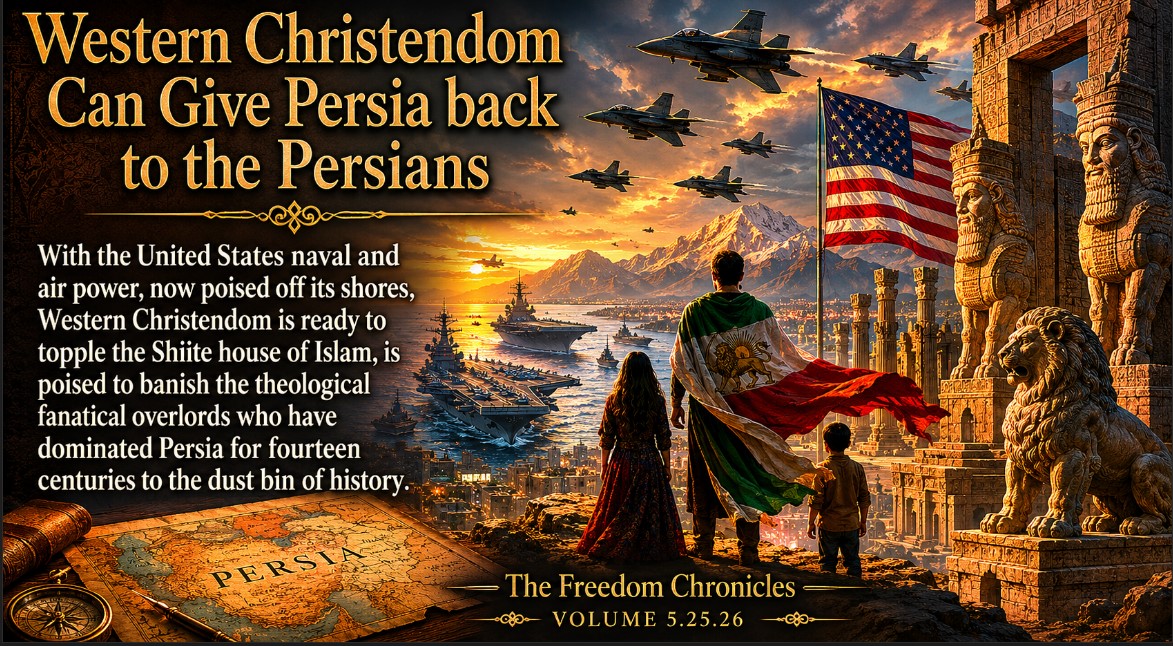
With the United States naval and air power, now poised off its shores, Western Christendom is ready to topple the Shiite house of Islam, is poised to banish the theological fanatical overlords who have dominated #Persia for fourteen centuries to the dust bin of history. The U.S. will make history not by taking the land of the Shiites but by giving it back to the Persian people.
1 Reader Comment
Join the conversation and share your thoughts.
Sherri Willson Oakley
From your mouth to God’s ears.